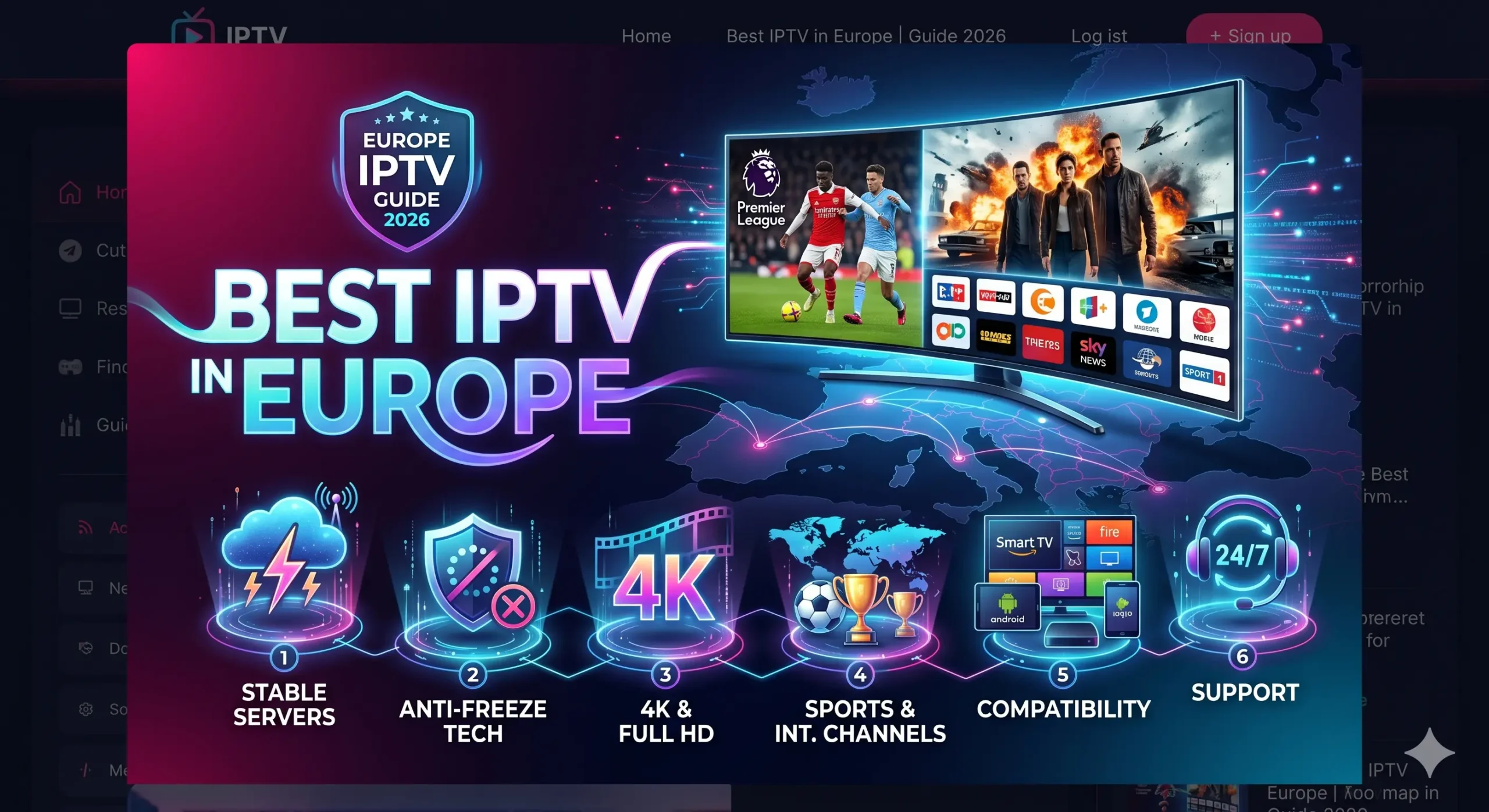
Choosing between IPTV providers in Europe usually comes down to a frustrating gamble: which service will actually stay online, let you watch the way you want, and not lock you into clunky software? Almost every provider looks identical on a sales page. The differences only appear after you have paid — when the stream stalls during the match you waited all week for, or when you discover you are stuck with one buggy app you cannot replace.
This guide sets out what separates a premium European IPTV provider from the dozens of resellers competing on channel counts: where the servers actually are, what you are free to install, what happens at peak time, and the warning signs worth checking before you commit to an annual plan.
The Death of the Megalist: Why Channel Counts Stopped Meaning Anything
The European market has changed. For years providers competed on vanity metrics — 30,000 channels, 50,000, 100,000 — as though the number itself were the product. Anyone who has actually lived with one of those lists knows the reality: a large share of the channels do not work, the programme guide is wrong, and support disappears when you ask about it.
The reason is structural, not accidental. Most budget services are resellers. They buy capacity on a single overloaded server and sell it to thousands of people. On a quiet Tuesday morning it works perfectly well, which is exactly why the free trial impresses. Then the Premier League kicks off, several thousand subscribers press play within the same ten minutes, and the server chokes. Nothing about the channel count changes that — the list was never the constraint. Bandwidth was.
So the useful question in 2026 is not how many channels a provider claims. It is how much dedicated capacity sits behind the ones you will actually watch, and how close that capacity is to your house. Everything below follows from that.
What to Look for in the Best IPTV Providers in Europe
After analysing what European viewers search for — and, more usefully, what they complain about — five factors consistently separate the better providers from the rest.
1. Server stability and local infrastructure
The single biggest cause of buffering is distance between you and the server. A provider streaming everything from one distant data centre will lag for half the continent. The better services run local hubs so that a viewer in Scandinavia and a viewer in Iberia each connect to something near them. When comparing providers, ask directly: where are your servers, and which one will I connect to? A vague answer is a red flag.
2. Genuine 4K and anti-buffering performance
"4K" on a sales page means nothing without the bandwidth and load balancing to deliver it. Premium providers invest in capacity so that peak-time demand — Champions League nights, major finals — does not collapse the stream. A service that holds a clean feed during the biggest sporting events of the year will handle everything else comfortably.
3. App and device freedom
Lower-tier services lock you into one rigid app. The better providers let you use the player you already know on Firestick, Android, Smart TV, MAG box or iOS. This is one of the most common reasons long-term subscribers say they switched — and stayed.
4. Honest, long-term pricing
Monthly plans look cheap and add up fast. Real value sits in annual pricing that locks a low effective monthly rate and includes multi-device access rather than selling it back to you as an upsell.
5. Safe, flexible payment
A frequent and entirely reasonable hesitation is handing card details to an unfamiliar site. A serious provider offers established checkout options so you are never typing raw card numbers into a form you do not recognise.
Reseller or Operator? The Distinction That Decides Everything
The word "premium" is overused in this market — every provider claims it. The honest definition is operational rather than promotional: a premium service is one with the infrastructure, support and policies of a business that intends to be around in five years, not five months.
The practical distinction is between a reseller and an operator. A reseller rents capacity from someone else and marks it up. They do not control the servers, cannot fix a routing problem, and have no ability to correct a broken guide, because none of the infrastructure is theirs. When something fails, the honest answer they cannot give you is that there is nothing they can do. An operator runs its own nodes, decides where they sit, and can be held to account for how they perform.
This is why the question "where are your servers?" is so effective. A reseller deflects it, because the true answer exposes the model. An operator answers with place names. Four things mark out the second kind of business: local European server infrastructure rather than one distant data centre; freedom of player choice rather than a forced branded app; trusted payment processors rather than untraceable methods; and honest annual pricing rather than a parade of upsells.
Localized European Infrastructure: The Denmark and Spain Hubs
EuroTVBox runs dedicated premium server nodes placed close to its largest audiences rather than routing the whole continent through one location.
- Denmark hub — built for the low-latency fibre networks across Scandinavia, keeping Sweden, Norway, Denmark and Finland on short, stable routes for crisp 4K with instant channel switching.
- Spain hub — engineered to bypass local ISP throttling across Iberia, with a technical EPG offset fix that corrects channel-guide times for expats in Lanzarote and the wider Canary Islands, where time-zone errors normally break the programme guide.
The result is that whether you are a Nordic fibre user or a British expat on the Spanish coast, you connect to infrastructure built for your region rather than a distant server shared by everyone. Load balancing across those nodes is what keeps the stream steady when concurrent demand peaks — which is precisely the moment lower-tier providers collapse.
App Choice Liberty: Watch Your Way, Not Theirs
Here is a problem many people discover too late. A lot of IPTV providers force you into a single branded app — one they control, one you cannot replace, and in the worst cases one that installs unwanted software on your device. You are stuck with their interface, their bugs and their update schedule.
EuroTVBox does the opposite. You use the premium player you prefer — TiviMate, IBO Player or IPTV Smarters. No forced app, no injected software. You pick the interface you already know, and we deliver a stable stream to it.
"I had other IPTV providers, but I’m not happy with their service as they control which app I install on and they insert it. So I looked up best IPTV Europe providers, read up about all of them and you were the best by far."
— Verified EuroTVBox customer
Why your player says "sync is now out"
This message worries people more than it should. It usually means your player has lost its place in the stream because packets arrived too slowly or out of order — which is a symptom of latency and server load, not a fault in the app or your television. An oversubscribed server produces it constantly; a nearby, properly provisioned one almost never does. Being free to switch players also means you can rule the app out as a cause in about two minutes, which is something a forced-app provider will never let you do.
Generic Offshore Providers vs EuroTVBox Premium
Not all IPTV services are built the same. Here is how a premium, support-backed European provider compares with a typical bargain-bin offshore reseller:
| Feature | Generic offshore reseller | EuroTVBox Premium |
|---|---|---|
| App choice | Locked to one branded app | Free choice: TiviMate, IBO, IPTV Smarters |
| Server location | Single distant data centre | Local Denmark & Spain hubs |
| Peak-time stability | Collapses under load | Load-balanced infrastructure |
| Channel guide (EPG) | Wrong times, no fix | Timezone EPG offset fix included |
| Simultaneous devices | Usually 1 | Up to 3 (Family Pass) |
| Payment | Untraceable / risky methods | SumUp, Google Pay, Apple Pay |
| Support | Slow or none | Responsive, European-focused |
Red Flags to Watch For Before You Pay
A service marketing itself as high-end is not necessarily one. Before committing to any annual plan, check for these warning signs:
- No visible business address or company information. Anonymous operators tend not to be around for long. A legitimate service has a public footprint.
- Crypto-only or wire-transfer-only payment. Trusted providers use established processors. Refusing them is a tell.
- Lifetime subscriptions or absurdly cheap multi-year deals. No infrastructure-backed service can sustain that pricing. The offer collapses before delivery does.
- Forced installation of a specific app. The first thing a serious operator does is let you choose your tools. A forced app is a forced dependency.
- No trial or money-back option. Confident providers stand behind their stream. Reluctance to let you test is reluctance to be judged.
Run this five-point check on any provider you are considering. It rules out the worst of the market in under a minute.
Device Compatibility: Works With What You Already Own
Because EuroTVBox does not lock you into a proprietary app, it works across hardware you already use. There is no need to buy a special box or learn an unfamiliar interface — install your preferred player and connect.
- Amazon Firestick & Fire TV — the most popular streaming device in Europe, and the most common source of buffering complaints when a provider is poorly optimised.
- Android TV, phones & tablets — full flexibility with TiviMate, IPTV Smarters or IBO Player.
- Smart TVs (Samsung, LG and others) — native players without extra hardware.
- MAG boxes — fully supported for users who prefer dedicated set-top hardware.
- iOS & Apple TV — for households built around the Apple ecosystem.
Most providers claim this list. The differentiator is whether you are free to choose your own player on each device rather than being locked into one app. Device-specific walkthroughs are available for IPTV on Smart TVs across Europe and for the Amazon Firestick.
Fixing the Two Problems That Make People Switch
A large share of "bad provider" reviews describe fixable configuration issues rather than a broken service. Knowing the difference tells you whether a provider’s support is competent — and whether the fault is theirs at all.
Buffering at peak times
Buffering is usually a mix of an overloaded server, which is the provider’s responsibility, and local Wi-Fi or app-cache issues, which are yours. The useful diagnostic is timing. If playback stalls only in the evening, at weekends, or during major fixtures, the line is oversubscribed and no amount of local tinkering will fix it. If it stalls at all hours and on one device only, start with cache, player choice and signal strength. A good provider will walk you through clearing cache, switching players and connecting to a closer node rather than reflexively blaming your connection.
Full diagnosis in our guide to fixing IPTV buffering in Europe.
Wrong programme times: the Canary Islands EPG offset
If your channel guide shows the wrong times, that is almost always a timezone problem — an EPG offset error — rather than a broken service. It is the single most common complaint from expat viewers, and it has a specific geographic cause. The Canary Islands sit one hour behind mainland Spain, so a guide built for peninsular time displays every programme an hour out for viewers in Lanzarote, Fuerteventura, Gran Canaria and Tenerife. A recording set from the guide starts at the wrong moment; a match appears to begin an hour late.
Most providers never address this, because correcting it requires control over the guide data rather than passing through someone else’s feed. EuroTVBox includes an EPG offset fix so the guide matches your local clock wherever you are — which is why the Spain hub matters as much for expats as it does for residents on the mainland.
Island-specific setup is covered in our IPTV Canarias and Lanzarote guide.
Built for Every Corner of Europe
Europe is geographically compact but network-fragmented, and a provider optimised for one region can be unusable in another.
UK & Ireland
Home to the heaviest demand for premium sport in Europe, which means infrastructure quality shows immediately. Low latency to Northern European routing delivers near-instant channel switching and stable 4K — the difference between catching every second of a match and missing the goal to a buffering wheel.
Spain, Italy & Southern Europe
The dedicated Spain hub keeps streams stable across Iberia and into Italy, bypassing the local ISP throttling that cripples lesser services. Combined with the EPG offset fix, it is built for both residents and the large expat communities along the Spanish coast and islands.
France & Benelux
Broadband quality across France, Belgium and Luxembourg is high, so viewers here notice lag instantly and have little patience for it. Clean Northern European routing is what meets that standard, and it is the reason these markets are unforgiving of providers running a single distant node.
Netherlands & Central Europe
The Netherlands sits on some of the best internet backbone in the world, so Dutch viewers notice lag instantly and expect more. EuroTVBox routes cleanly through Northern European infrastructure to meet that standard, and the same routing serves Germany and Austria reliably.
Scandinavia & the Baltic
The Denmark hub is tuned for the region’s low-latency fibre networks, keeping Sweden, Norway, Denmark and Finland on short, stable routes. Without a nearby node, Nordic users are usually the first to experience buffering — which is exactly why we built one.
One Plan, Three Screens: How Households Actually Watch
Single-device limits are a hidden cost. Most households do not watch on one screen — the living-room television, a bedroom set and a tablet are frequently in use at the same time, and a plan that allows one connection quietly forces a second subscription or a nightly argument.
Device allowances scale with plan length:
- 1-Year Pack — 3 simultaneous devices (Family Pass), plus free app player activation.
- 6-Month Plan — 2 simultaneous devices.
- 3-Month Plan — 1 device.
If more than one person in your home watches television, the Family Pass on the annual plan is usually the difference between a service that fits your household and one you end up working around.
What Real Value Looks Like in 2026
The cheapest plan is rarely the best value. Monthly billing suits people who genuinely want to test a service for a few weeks, but the effective cost is high and the recurring charge is a monthly opportunity to churn.
Annual plans deliver the real saving, and the better ones include multi-device access and bundled extras rather than selling them separately. The 1-Year Pack at €67.99/yr includes the Family Pass for 3 simultaneous devices, free 1-year app player activation worth €15, priority access to the Denmark and Spain hubs, and full 4K with anti-buffering load balancing.
That works out to roughly €5.67 a month for three devices with the player activation included — the lowest effective long-term cost of any serious European provider, without the friction of recurring monthly billing. For most households the sensible path is a short trial to confirm stability in your own region, then the annual plan to lock the rate.
Try It Before You Commit
No amount of reading replaces testing the stream from your own home, on your own device, in your own region. Providers offer a free trial precisely because they are confident the infrastructure will hold — and reluctance to let you test is the most reliable warning sign in this market.
Use the trial to check three specific things: how fast channels switch, whether 4K holds during peak evening hours rather than at midday, and whether your preferred device and player work without fuss. Testing at 11am tells you almost nothing; testing during a Saturday fixture tells you everything.
The most reliable way to judge any provider on this list is to test it yourself — start with a free 24-hour IPTV trial, then compare the shortlist in our review of the 5 best IPTV services in Europe.
Secure Payment: No Risky Card Forms
A common and completely reasonable worry: putting card details into an unfamiliar site does not feel safe. We agree. EuroTVBox uses established, trusted payment gateways — SumUp, Google Pay and Apple Pay — so you never type raw card numbers into a form you do not recognise. You check out through systems you already use, with the security protections they provide built in.
This is also a useful filter when assessing anyone else. Payment method is one of the clearest signals of what kind of business you are dealing with, because established processors impose accountability that untraceable methods are chosen specifically to avoid.
Support, and What Good Service Feels Like Day to Day
Infrastructure and player choice are the technical foundations of a quality service. Support is the human one, and the best technical setup in the world does not help if nobody answers when something goes wrong. A serious operator replies promptly, in clear language, without scripted boilerplate — acknowledging issues when they exist and explaining timelines for fixes.
This matters most at exactly the moments you would otherwise switch provider: a sudden buffering spell during an important match, a billing question that needs resolving now, an EPG misalignment after a daylight-savings change. How a provider handles those moments predicts long-term quality far better than any feature list. Contact support before you subscribe — the speed and tone of the reply tells you most of what you need to know.
The right service mostly disappears into the background. Channels switch instantly, the guide is accurate, the stream stays up during the match, and you stop thinking about the technology because there is nothing to fix. That is the standard. Anything demanding constant attention is not operating at a premium level, whatever the marketing says.
Frequently Asked Questions
Who are the best IPTV providers in Europe in 2026?
The best providers combine local server infrastructure, genuine 4K stability, freedom to choose your own app, and secure payment. EuroTVBox is built around all four, with dedicated Denmark and Spain hubs for low-latency streaming across the continent.
Can I use my own player like TiviMate or IPTV Smarters?
Yes. Unlike providers that lock you into a single branded app, EuroTVBox lets you use premium players such as TiviMate, IBO Player, or IPTV Smarters — your choice, no forced software.
How do I stop IPTV buffering in Europe?
Connect to a server close to your region. EuroTVBox’s Denmark and Spain hubs keep Nordic and Iberian viewers on short, stable routes, while load balancing maintains 4K quality during peak-time demand.
Why is my channel guide showing the wrong times?
That’s a timezone (EPG offset) issue, common for expats. EuroTVBox includes an EPG offset fix so the guide matches your local clock — particularly useful in Lanzarote and the Canary Islands, which sit an hour behind mainland Spain.
Is it safe to pay for IPTV online?
It’s safe when the provider uses trusted processors. EuroTVBox accepts SumUp, Google Pay, and Apple Pay, so you never enter raw card details into an unfamiliar form.
Are annual IPTV plans worth it?
For anyone planning to keep the service beyond a month or two, yes. Annual plans lower the effective monthly cost significantly and include multi-device access, while removing recurring billing friction.
Which devices work with European IPTV?
Premium providers support Firestick, Android TV and mobile, Smart TVs, MAG boxes, and iOS or Apple TV. The most important factor is whether you can use your preferred player on each device rather than being locked into one app.
Is premium IPTV worth the higher price?
When the annual plan works out to about €5.67 a month for three devices, premium is no longer expensive. The real cost is the time and frustration wasted on a service that buffers or disappears mid-subscription.
How do I know a provider is genuinely premium rather than a reseller?
Ask for specifics. Where are the servers physically located? Which players are supported? What payment processors are used? A genuine operator answers these directly. A reseller dodges them, because the honest answer would reveal that the infrastructure is not theirs.
Choosing Stability First
The best IPTV providers in Europe in 2026 win on one principle: stability first. Local server hubs across Northern and Southern Europe, real 4K capacity, freedom of app choice, honest annual pricing and secure payment together define a service worth staying with for years rather than weeks.
Channel counts will keep inflating, because they cost nothing to claim. Capacity, routing and a guide that shows the right time cost something real — which is exactly why they are the things worth choosing on. Use a free trial to confirm performance in your own region during peak hours, then commit annually to lock the best long-term value.
Leave a Reply